What Is Supported Independent Living (SIL)? A Complete Guide
If you've just heard the term "SIL" for the first time, or you're trying to work out whether it applies to you or someone you care for, you're in the right place. We'll walk through what SIL actually is, who qualifies, what it pays for, and what the whole process looks like in practice, without the jargon. If you're already familiar with the basics and want to see how it works at V Care specifically, you can jump ahead to our SIL services.
Quick answer: Supported Independent Living, or SIL, is NDIS funding that pays for support workers to help you with everyday tasks like personal care, cooking, and household jobs, while you live as independently as possible, usually in a shared home with other participants. It covers the support itself, not your rent or living costs.
Key Takeaways
- SIL is NDIS funding for daily support, not accommodation.
- SIL helps participants build independence.
- SIL can be provided in shared homes or your own home.
- Eligibility depends on your support needs and assessments.
- V Care supports participants across Newcastle, Maitland, Lake Macquarie, Hunter Valley and the Central Coast.
What Is Supported Independent Living (SIL)?
Supported Independent Living is a type of NDIS funding for people who need a higher level of support to manage daily life, often around the clock. Instead of moving into a clinical care facility, SIL is built around a different idea: you keep your independence, your own room, your own routine, and support workers come to you.
Most people on SIL live in a shared home with one or two other participants, and a team of support workers rotate through to help with things like showering, cooking, cleaning, and taking medication. Some participants live on their own with SIL support instead, depending on their needs and what their plan allows. Usually, SIL homes are set up around exactly this kind of person-centred model.
The key thing to remember is that SIL is a type of support rather than a living arrangement. It funds the people who help you, not the house you live in.
What Does SIL Funding Cover?
SIL funding sits under the NDIS and pays for support workers who help participants live as independently as possible in shared or individual accommodation. Basically, it covers your essential needs related with your needs, and doesn't cover auxiliary needs related to your lifestyle.
What does SIL Funding Include?
SIL pays for support workers to help with:
- Personal care, like showering, dressing, and grooming
- Meal planning and cooking
- Cleaning and household tasks
- Medication management, including monitoring from qualified staff where needed
- Learning skills like budgeting or catching public transport
- Overnight support, if you need someone awake or on call while you sleep
If your support needs include more clinical tasks, like wound care or ongoing health monitoring, that's usually coordinated alongside community nursing care rather than SIL alone.
What SIL Funding Doesn't Cover
Here's where a lot of people get tripped up. SIL does not cover:
- Your rent or mortgage
- Groceries and everyday bills
- Getting around, unless it's funded separately in your plan
- Things like outings, hobbies, or entertainment
So if you're picturing SIL as "the NDIS pays for my house," that's not quite right. SIL pays for the people helping you inside the house. The house itself is usually covered separately, either by you personally or through a different type of funding called SDA, which we'll get to shortly.
Who Is Eligible for Supported Independent Living?
NDIS Eligibility Requirements
Before SIL even comes into the picture, you need to be an NDIS participant. That means being between 7 and 65 when you apply, an Australian citizen or permanent resident, and having a permanent disability that makes everyday activities significantly harder without support.
High Support Needs Assessment
SIL specifically is for people who need a lot of support, not just a little help here and there. The NDIS will look at things like whether you need someone available 24 hours a day, whether you need several hours of hands-on help every day, and whether it would be genuinely unsafe for you to be home alone without support.
Evidence Required (OT Report & Roster of Care)
To apply, you'll usually need two key pieces of evidence. The first is a report from an Occupational Therapist confirming exactly what kind of support you need. The second is something called a Roster of Care, which is basically a weekly timetable showing when support is needed and for how long. Your Support Coordinator will usually help pull both of these together with you.
Where Can Supported Independent Living Be Delivered?
Shared or Group Homes
This is the most common setup. You live with one or more housemates, and support hours are shared across the household, which tends to make the funding go further.
Specialist Disability Accommodation (SDA)
Some participants live in SDA housing, which is purpose-built or specially modified for people with significant support needs. SDA pays for the building. SIL pays for the support delivered inside it. It's common to have both types of funding at once.
Private Rental or Your Own Home
In some cases, SIL support can be delivered in your own home or a private rental instead of a shared arrangement. This depends on your individual needs and what's approved in your plan.
How to Apply for Supported Independent Living (SIL)
Step 1: Speak with Your Support Coordinator
This is always the first move. Your Support Coordinator helps you figure out whether SIL is genuinely the right fit, and they guide you through everything that follows.
Step 2: Functional Assessment & Roster of Care
Next, an Occupational Therapist or another allied health professional assesses your needs in detail, and your Roster of Care gets built based on that assessment.
Step 3: Choose the Right SIL Provider
Once your funding and needs are confirmed, you'll work with your Support Coordinator to find a home and a provider that suits you, which we'll cover in more detail further down. If you'd like a head start, you can get in touch with our team at any point in this process, even before your funding is finalised.
Levels of Supported Independent Living Support
SIL funding generally falls into three levels, depending on how much support you need.
Lower Support Needs
Support is there when you need it, but not constantly. This usually means supervision rather than hands-on help all day. You might have a support worker check in a few times a day, help with specific tasks like meal prep, and be available on call if something comes up.
Standard Support Needs
Support is available throughout the day and night, including overnight, with active help for most daily tasks. In practice, a support worker is generally on-site or sleeping over, actively assisting with personal care, meals, and household tasks as they come up.
Complex Support Needs
This level is for participants who need frequent, intensive support, including help with complex medical needs or behaviours, along with support available 24/7. At this level, support often overlaps with community nursing for participants who need clinical oversight alongside daily support. Multiple support workers may be rostered at once, often with specialised training in areas like clinical care or positive behaviour support.
Supported Independent Living (SIL) vs Specialist Disability Accommodation (SDA)
This is one of the most common points of confusion, so let's clear it up simply. SIL funds the support, meaning the people who help you day to day. SDA funds the building, meaning specially designed or modified housing for people with significant support needs.
| Supported Independent Living (SIL) | Specialist Disability Accommodation (SDA) | |
|---|---|---|
| What it funds | Support workers and daily assistance | The physical home itself |
| Covers | Personal care, meals, cleaning, medication support | Purpose-built or modified housing |
| Answers the question | Who helps you? | Where do you live? |
| Can you have both? | Yes, commonly paired together | Yes, commonly paired together |
Think of it this way: SDA is about where you live, SIL is about who helps you while you're there. Many participants have both at the same time, and that's completely normal.
Supported Independent Living (SIL) vs In-Home Care
While both Supported Independent Living (SIL) and In-Home Care help NDIS participants live more independently, they are designed for different levels of support and living arrangements.
| Supported Independent Living (SIL) | In-Home Care |
|---|---|
| Designed for participants with higher support needs | Suitable for participants who need occasional or regular support at home |
| Support is often available throughout the day or 24/7 | Support is provided during scheduled visits |
| Commonly delivered in shared SIL homes or approved accommodation | Delivered in your own home or private residence |
| Focuses on developing independent living skills while providing ongoing daily support | Focuses on assisting with specific daily tasks while you remain at home |
| Funded under NDIS Supported Independent Living | Funded through relevant NDIS support categories |
The right option depends on your individual needs, goals, and NDIS plan. If you're unsure which support is most suitable, V Care's team can help you understand your options and choose the right service for your circumstances.
A Day in Supported Independent Living
It helps to picture what daily life actually looks like, because "support" can sound vague until you see it in action.
A typical day might start with a support worker helping you get ready in the morning, then preparing breakfast together before you head off to work, a day program, or a community activity. Through the day, support workers might check in to help with laundry or start dinner.
In the evening, there's usually a shared meal with housemates, some downtime, and support on hand for whatever comes up, whether that's winding down for the night or working on a personal goal like managing your own budget. Many participants also build in regular community participation activities as part of their week, whether that's a social group, sport, or volunteering.
Every SIL home looks a little different, because support is meant to be built around you, not the other way around.
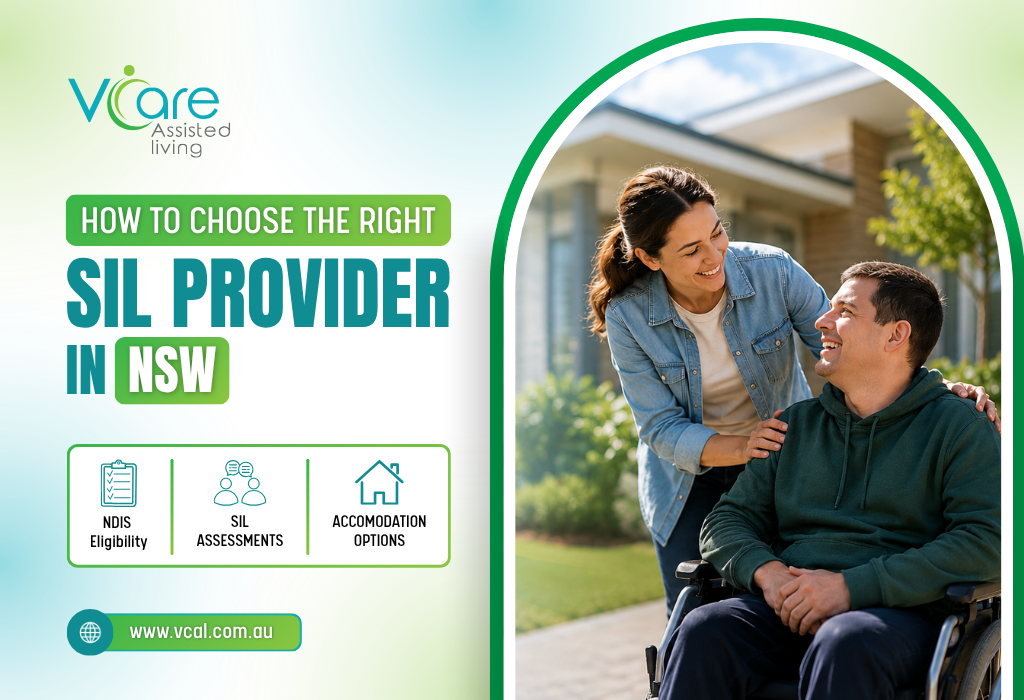
How to Choose the Right SIL Provider
Picking a provider is a big decision, so it's worth asking the right questions upfront.
Choosing a provider with strong local knowledge can make a significant difference to your experience. V Care delivers personalised NDIS Supported Independent Living services throughout Newcastle, Maitland, Lake Macquarie, Hunter Valley, and the Central Coast, ensuring participants receive consistent support close to their families, healthcare providers, and community networks.
Are they a registered NDIS provider?
Registration means the provider is regularly audited and held to NDIS quality and safety standards, which is worth confirming early. V Care is a registered NDIS provider across NSW.
How experienced is their staff?
Ask specifically about training and experience in SIL and disability support, not just general care experience.
Do they build personalised support plans?
A good provider works around your goals and routine, not a fixed template applied to everyone.
What's the home environment actually like?
Visit before deciding. Meet potential housemates and get a genuine feel for whether the home suits your lifestyle. You can see what's currently available on our SIL homes page.
What do current participants and families say?
Where possible, talk to people already living in one of the provider's homes. Real feedback tells you more than a website ever will.
Final Thoughts
If you're ready to explore Supported Independent Living, our team at V Care Assisted Living is here to help. We support participants across Newcastle, Maitland, Lake Macquarie, Hunter Valley, and Central Coast with SIL, personal care, and community nursing, all built around what actually works for you.
Reach out through our contact page or referral form, and we'll walk you through what comes next.
Read Other Blogs